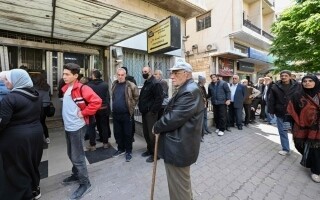
Despite the fact that some corners, including the European Union, have begun to ease sanctions against Damascus, it has not yet been said that citizens of Syria feel it in their everyday lives. In front of the building of the State Commercial Bank stood about three hundred people in winding queues, slowly moving forward, among them those who settled on the ground, tired of a long wait. A state employee, Afraa Jumaa (43 years old) confirms that she spends the money she manages to withdraw to pay for groceries. "The situation is complicated, we need our salaries to be received and withdrawals of deposits to be made as soon as possible, and not to have to wait days for small sums," she says. "We have to delay obligations until we receive our money, and this is not always possible, and people require rent payments and cover long-standing debts."
Economic expert Jorge Hazam explains the deficit of cash in circulation with a deliberate "draining" of the local currency to quickly provoke trading bubbles on the market and earn quickly. "The less money in circulation in the Syrian lira, the more likely it is for traders to trigger the necessary dollar-raising bubbles," he adds.
The crisis in Syria, lasting 14 years, has exhausted the local economy, and its crisis has increased the strains on non-governmental organizations, mostly Western, sanctions against the previous regime. The central bank obligated state and private banks to maintain a strict limit on cash withdrawals at 200 thousand lira (approximately $20) per person, which could be increased in the presence of liquidity, according to the words of a staff member of a private bank.
This crisis has increased the burden on Syrians in a country where 90% of the population lives in extreme poverty, according to the UN. Of them, some take a day off to try to withdraw a small part of their salaries. Before the beginning of the conflict in 2011, the dollar was worth about fifty lira, before the local currency gradually began to steadily lose its value and has lost more than ninety percent of its value from its worth.
Meanwhile, when a woman in a white dress, Munthaha Abbas (37 years old), receives her salary in 500 thousand lira, she needs three attempts to take her monthly salary entirely. And, after waiting five hours, she managed to get 200 thousand lira to repeat the attempt the next day, saying: "There are many banks in Damascus, but they only work with some of them, and the reason, in my opinion, is the absence of sufficient amounts of cash."