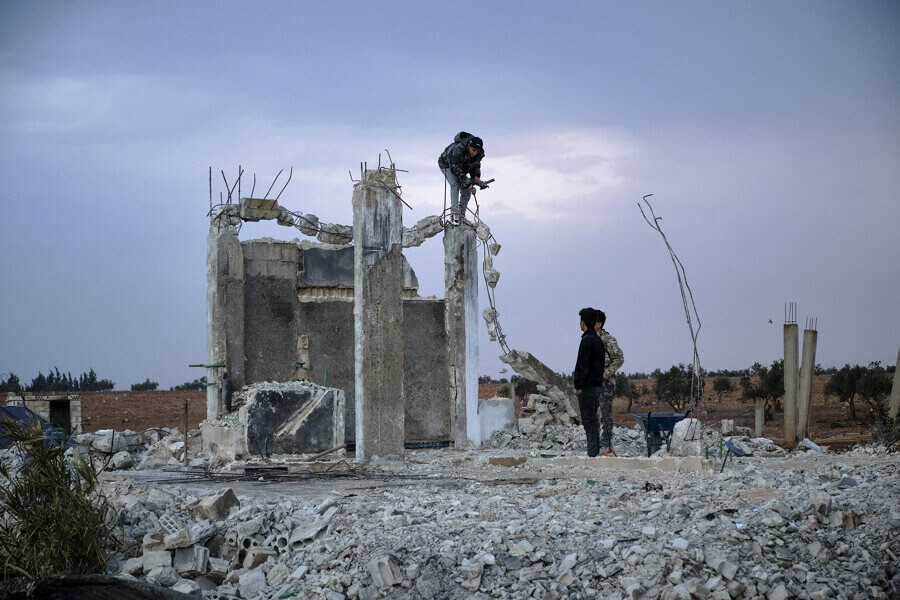
A year after the fall of Bashar al-Assad, the destroyed Syrian village of Buwaidah al-Sharqiyah has welcomed back many of its neighbors who fled during the civil war. They have now chosen to trade refugee camps for tents in their own homeland. According to UN data, around two million internally displaced people have returned to their areas of origin in Syria following the change in power, and over a million refugees have returned from other countries, despite the ongoing reconstruction process and the scarcity of basic services. The family of Fátima Azin Hamoud returned to Buwaidah al-Sharqiyah just ten days after the fall of al-Assad. It took them that long to dismantle their tent in Lebanon and gather the $600 needed to rent a large enough vehicle to transport their belongings across the border. «You spend 13 years of your life living in a tent in Lebanon, and now you come back with your children to the same tent. It just destroys you. It's bad enough that you lived in a country that wasn't yours, and now in your own country you live in a tent,» she laments. Fátima's husband, Nihad Ahmed Hamud, spent 13 years in Lebanon. He defends their return: «I'm not saying that everything is better now, because we have returned to a completely destroyed area... But we are here in our country». Unlike others, Nihad wandered for a long time: first, he fled to another Syrian village for seven years; then the old regime forced him back to Buwaidah, and finally, he left the country to save his sons from mandatory military service. He doesn't forget the day that finally allowed him to return to his land without fear, December 8th when al-Assad fell, nor the celebrations that lasted all night in their refugee camp in Lebanon. «In the morning, people were already preparing to return, even though they knew they had no houses, schools, hospitals, electricity, or water, and that there was no life in their land... We have nothing, no work, but we are happy and safe in our country,» he concludes. Fátima confirms that every single neighbor fled the village at the height of the conflict that began in 2011. In their case, they only left when Buwaidah was besieged in 2013, after enduring a year and a half of violence «without bread, without gas, without water or anything». «We said, that's it, we have to go back, even knowing there was no house or place to go,» Fátima points out. Upon returning to Buwaidah al-Sharqiyah, they found a situation she describes as «very disastrous» and only a few dozen families had also returned with their tents to live, back then, without electricity, water, or any commerce to get supplies. Before the war, Mohamed al-Ekesh had a 180 m² house here that is now on the ground, like almost all the houses in the village. «We started clearing the rubble from the destroyed houses ourselves, which took almost all the money we had,» explains the resident. «The 400 or 500 dollars we paid to clear the rubble could almost have served to lay the foundations for a house,» he explains. Mohamed maintains that all the neighbors who returned from Lebanon in the last year are in debt for at least $1,000, because, like him, they spent all their savings clearing the land and erecting temporary structures to shelter from the cold.